Blog | Manu Jayadharan
My research program centers on stable algorithms for forward and inverse scientific computing problems. Across everything I work on, three commitments stay constant: stability (algorithms that do not silently fail under noise, discretization, or optimization choices), interpretability (models scientists can reason about: sparse, symbolic, mechanism-level), and usability (methods released as well-tested open-source software). Here is an overview of what I have been working on at Northwestern.
Introduction
In this post, I will discuss the pros and cons of financial modeling, specifically in the case of stock option pricing. I will talk about why financial models are imperfect and less predictive compared to models derived from physical laws. I will provide the definition and usage of Greeks from the perspective of a mathematician and share my thoughts on their application.
I have made several simplifications of concepts in this post to make the reading short and comprehensive. I am also talking about modelling of financial instruments and not algorithmic trading which is a different topic.
This post is inspired by a similar post I wrote on Reddit on a related topic. This post can be found here.

What are Options ? Can we model them perfectly ?
- Role of Options: Options are perhaps the most powerul instrument in the trading world, offering the right, but not the obligation, to buy or sell an asset at a predetermined price, making them essential for both trading strategies and hedging risks. The asset or underlying of an option could be anything like stocks, bonds, commodities, etc. It gives the traders an “option” to buy or sell their securities under certain conditions.
Since stock options are the most common type of options (at least from the perspective of mere mortals, aka retail traders like us), I will focus on discussing these options for the remainder of this discussion.
FluidLearn is a software package with python interface, capable of solving non-linear fluid flow problems using supervised deep learning techniques. The solution function and the PDE operator are approximated as neural networks, which will be trained using labelled data.
Conceptually, this API could be used to solve any well-posed PDE system on complex geometric structures, given enough labelled data in the form of boundary and initial conditions. The architecture could also be used for physical parameter estimation and surrogate modelling. As of now, the package is oriented towards PDE systems governing fluid flow problems with many popular flow systems inbuilt. Users have the option to train the model from external data, visualize the training curves, save the model, reload the model, continue training the saved model or make predictions from the saved models.
The package could be seen as an application of the Physics Informed Neural Networks (PINNs) which are artificial neural nets trained with PDE constraints. The idea was first introduced in this publication in 2017. For more details on the mathematical theory behind PINNs, please visit the website maintained by the authors of the aforementioned publication here.
A graphical representation of a feed forward type neural net used in the training is shown below.
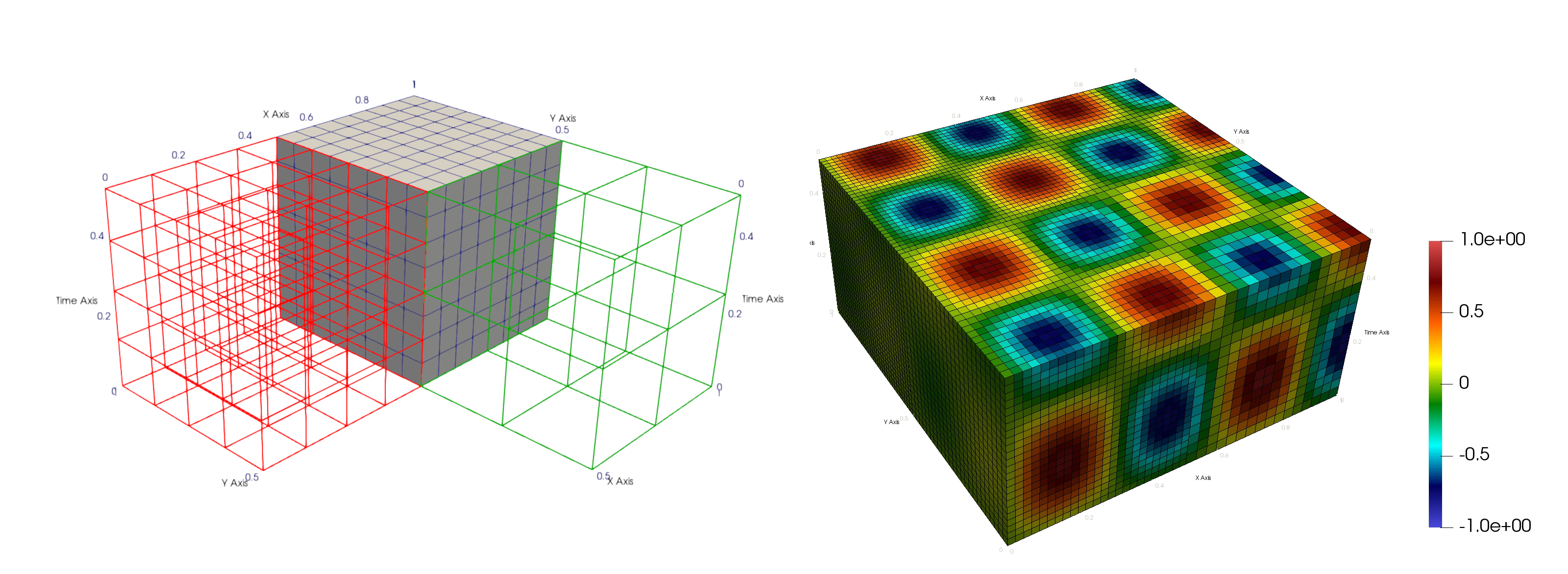
Fluid flow simulator using multiscale space-time domains.
Full repository can be found here.
Code developed to simulate time-dependent diffusion problem using Multiscale Mortar Mixed Finite Elements(MMMFE). Model can be easily adapted to simulate other fluid flow models based on linear PDEs. The novelty of the simulator lies in using multiple subdomains with variable time steps and mesh size for each subdomain. This give rise to a space-time DD technique allowing non-matching grids for sub-domains in both space and time dimensions. Sub-domain solves are done in parallel across different processors using MPI. Computed solutions are outputted and visualized on a global space-time grid in the .vtk and .vtu formats. Details of the spaces used and rough algorithm can be found in report.pdf and algorithm.pdf respectively. Theoretical results guaranteeing convergence and stability of the problem along with a priori error estimates are proved and being published.
Note:
- The simulator is written using deal.ii FE package which is based on C++.
- All instructions are with respect to a terminal in linux/mac. Please use the ubuntu sub-system if you are using windows 10. A good installation guide for the linux sub-system can be found here.
- Image/animation processing and visualization can be done using paraview. Installation guide can be found here.
Author
Manu Jayadharan, Department of Mathematics at University of Pittsburgh 9/17/2019
email: manu.jayadharan@gmail.com, manu.jayadharan@pitt.edu
researchgate
linkedin